


The goal
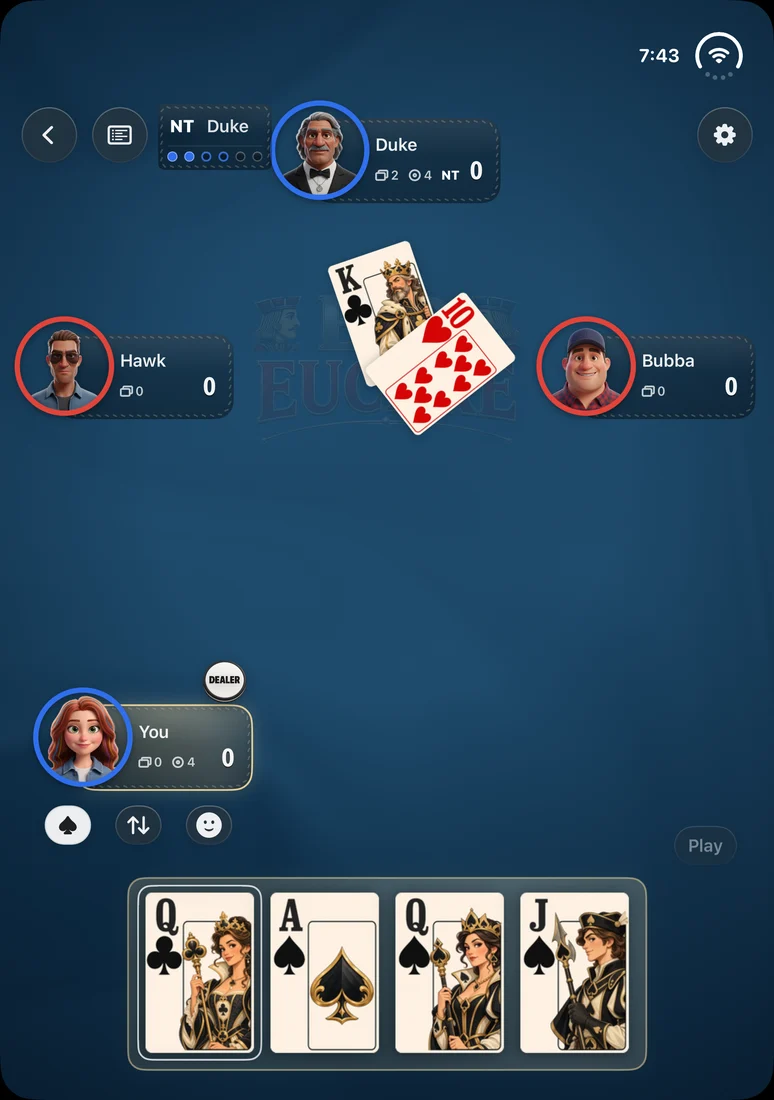
In Bid Euchre you and the seat across from you are partners. The first side to thirty-two points wins. Each hand has six tricks. You bid how many your side will take, then you choose trump.
The deal
Twenty-four cards, nine up to ace, six to each player. The whole deck is dealt. There is no turned card and nothing set aside. You bid on a hand you have seen in full. The high card of a cut deals first. The deal moves one seat left after every scored hand, and stays where it is when a hand is thrown in.
You bid a number of tricks, not a suit. The rungs are three, four, five, six, and then twelve or twenty-four. Twelve and twenty-four are alone bids, played without your partner. There is no alone bid on fewer than six tricks. Everyone bids once, starting left of the dealer, and the dealer bids last. Each bid must be a higher rung: a suit never breaks a tie. If all four pass, the hand is thrown in, nobody scores, and the deal is lost: it passes to the next dealer on the left. With stick the dealer on, the dealer must bid instead. The lowest opening bid and the winning score are table options: three and thirty-two unless the table changed them.
Winning the auction is only half of it: you then declare trump. You may name a suit, or no trump at all. You may also name low no trump: there are no bowers, and in every suit the nine is the highest card and the ace the lowest.
The play
Under a suit the two jacks work as in Euchre. The jack of trump is the right bower and beats everything. The jack of the same colour is the left bower and counts as trump. Under either no trump strain there is no trump at all.
Follow the suit led if you can. Otherwise play anything: you never have to trump, and you may lead whatever you like. The highest trump wins the trick, or the highest card of the suit led if no trump was played. In low no trump, it is the lowest card of the suit led instead.
On a twelve you play alone, but first you trade one card: your partner picks a card to give you, then you hand back any of your seven, even that one. On a twenty-four bid you play alone with the hand exactly as dealt. Either way your partner's seat is empty: tricks have three cards, and a first lead that would fall to that seat passes to the next one.
Scoring
Make a bid of three to six and you score the tricks you actually took. Bid four, take five, and you score five. The other side always scores the tricks it took.
Fall short on any bid and you lose its value instead. Bid five, take four, and five come off. An alone bid scores its full twelve or twenty-four when made, and loses the same when it fails. The other side scores its tricks either way.
Winning
Play hands until a side reaches thirty-two. Both sides usually score in a hand, so the higher total wins; if the two are level, play another hand. That side wins the game.