


The goal
In Bridge you and the seat across from you are partners. Your side bids a contract: how many tricks you will take, and with what trump. Make the contract and you score. Win two games and you win the rubber.
The deal
A full deck, thirteen cards each, nothing left over. The dealer opens the auction. Not the player to the dealer's left, which is how most other games at this table work. For the first deal each seat cuts a card and the highest deals: aces high, and on equal ranks spades, hearts, diamonds, clubs. After that the deal moves one seat left.
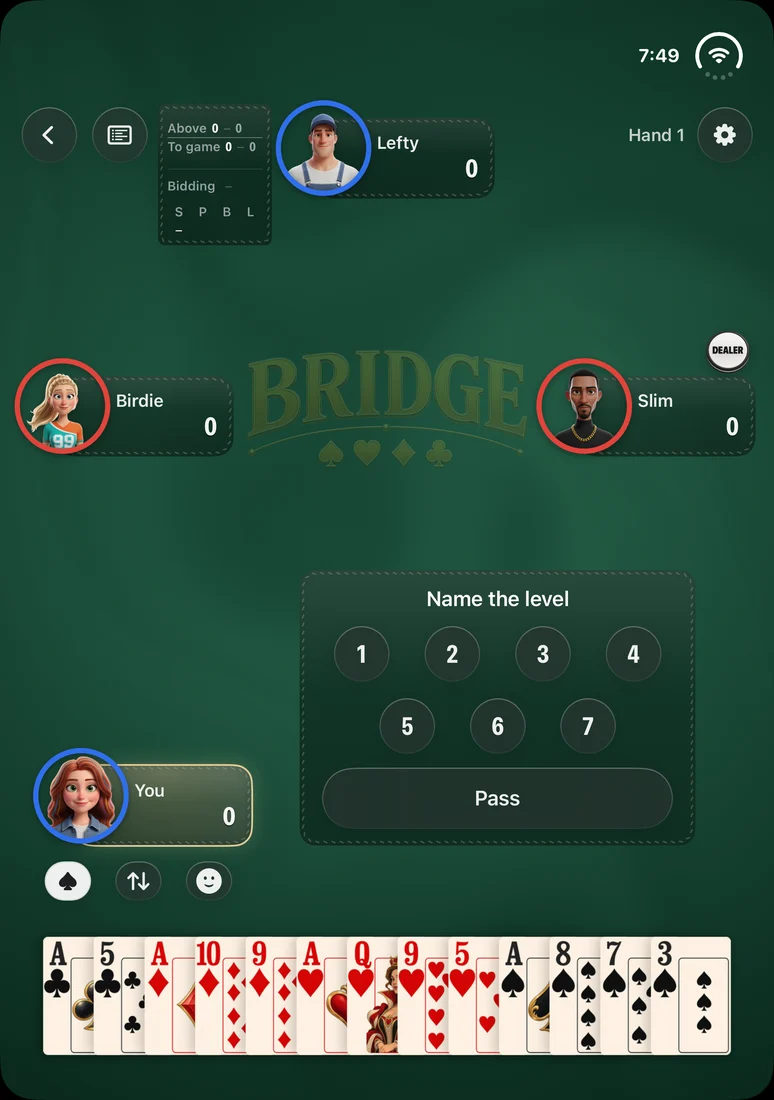
A bid names a level, one to seven, and a strain: a suit or no trump. The level is tricks beyond six. Each bid must beat the last: a higher level, or the same level in a higher strain. Clubs are lowest, then diamonds, hearts, spades, and no trump on top. You may pass, or double the opponents' bid if it is not doubled yet. Redouble only when your own side's bid has been doubled. A new bid clears both.
Three passes after any bid settle the contract. Four passes with no bid throw the board in: nothing scores, and the next dealer deals again. The declarer is the first player on the winning side to have named the final strain, not always the last bidder.
Count your hand before you bid: an ace is four points, a king three, a queen two, a jack one. With twelve or more, open the bidding. Balanced (no void, no singleton, one doubleton at most) with 15 to 17? Open one no trump. Otherwise open a five-card major, or your longer minor.
When your partner opens, answer with six points or more. With fewer, pass: between you there is no game. Three cards in partner's major is a fit. Raise it to two with 6 to 9 points, to three with 10 to 12, and straight to four, a game, with 13 or more. About twenty-five points between the two hands makes a game. So over one no trump, bid three no trump with ten or more.
The play
The player to the declarer's left leads first. Then the declarer's partner lays their whole hand face up and takes no further part. The declarer plays both hands from that point on. The two hands are one side: every trick the dummy wins counts for the declarer, and the defenders count their tricks together too.
Follow the suit led if you can. Otherwise play anything: there is no restriction on leading. The highest trump wins the trick, or the highest card of the suit led if no trump was played. The winner leads next.
Scoring
In rubber bridge, tricks bid and made score below the line: twenty each in a minor, thirty in a major. At no trump the first is forty and the rest thirty. Three hearts made is ninety. Each overtrick scores above the line: twenty in a minor, thirty in a major or no trump. Only the tricks you bid count toward a game.
A hundred below the line wins a game. Two contracts of sixty do it, and the count starts again for the next game. A game wipes both sides' part-scores. Sit on sixty and let the opponents make a game first, and your sixty no longer counts toward one.
A double makes the trick score twice as much, and a made contract adds fifty for the insult. A redouble makes it four times, and a hundred. Doubled overtricks are a hundred each, two hundred vulnerable, in any strain. Redoubled, twice that.
Fall short and the defenders score above the line for every trick you missed: fifty each, or a hundred each if you are vulnerable. Doubled it climbs: 100 for the first, 200 for the second and third, 300 each after. Vulnerable: 200, then 300 each. Redoubled, twice that.
Win a game and your side is vulnerable for the rest of the rubber. Vulnerable, going down costs more, and slams and doubled overtricks pay more. Bid and make six for a small slam: 500, or 750 vulnerable. Bid and make all seven for a grand slam: 1,000, or 1,500 vulnerable.
Honours: four of the ace, king, queen, jack and ten of trumps in one hand score 100, all five 150. At no trump, all four aces score 150. They count from the hand as dealt and go to the holder's side, declaring or defending, made or not. Honours are on unless the table turns them off.
Winning
Two games win the rubber, and the rubber ends the match. Winning it adds seven hundred, or five hundred if the other side won a game. The side that takes the second game wins the match, whatever the other side has scored. There is no limit on deals: a rubber lasts until one side has won two games, however many boards that takes.