



The goal
In Mahjong you build a winning hand of four sets and a pair, fourteen tiles in all. The first player to complete one worth at least three faan wins the hand and is paid for it.
The deal
Four players, everyone for themselves. A hundred and forty-four tiles: three suits numbered one to nine, four winds, three dragons, and eight flowers and seasons. Thirteen tiles each, and the dealer draws a fourteenth to begin.
Flowers and seasons are set aside as they arrive and replaced from the wall. They score, but they are never part of a set.
The play
Draw a tile and then discard one, keeping thirteen. A set is three of a kind, three in sequence in one suit, or four of a kind. A four-of-a-kind draws a replacement tile from the wall, so your hand only ever looks off by one tile in flight.
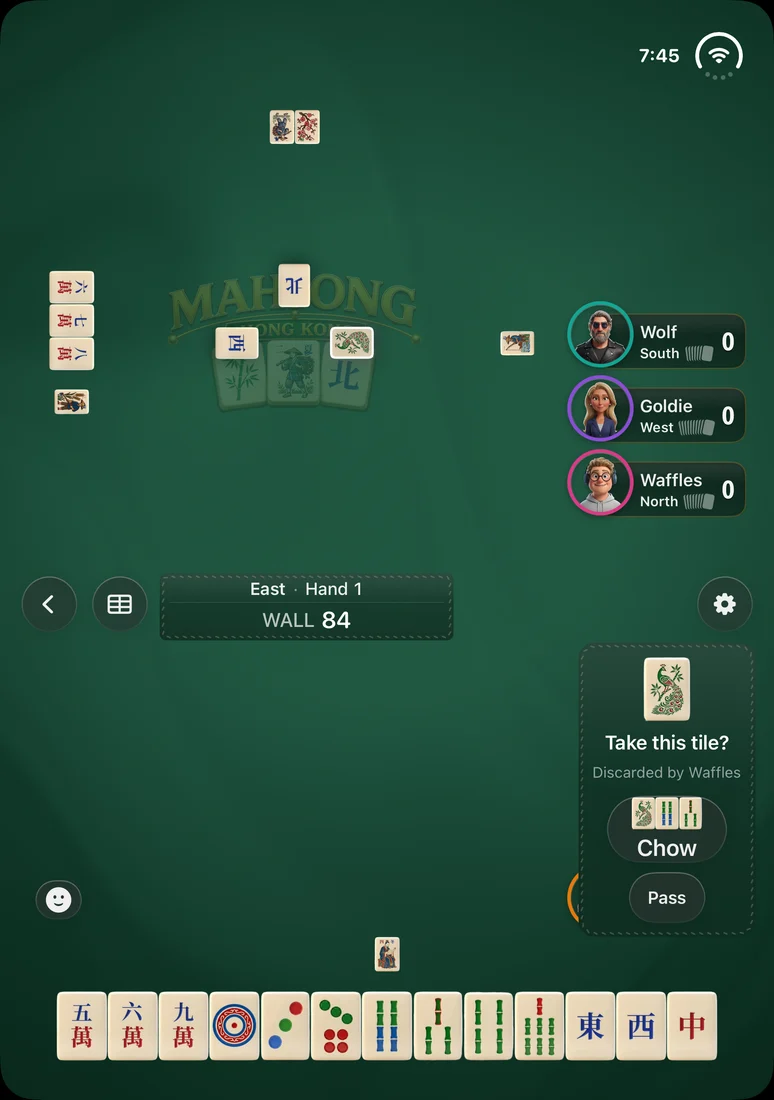
When somebody discards, you may claim it: for a win, for three of a kind, for four of a kind, or to complete a sequence. Only the player right after the discarder may claim a sequence, so you chow from the player on your right. You then discard without drawing, unless you claimed a kong, which draws a replacement first. After any claim, play carries on from the claimer. The seats in between lose their turn.
A win beats any other claim. Three or four of a kind beats a sequence claim. A discard nobody can legally claim simply passes by. If two players could win on the same discard, the one next in turn after the discarder takes it. Holding three of a discarded tile, you may claim it only as a kong, never as a pung.
Online you have five seconds to answer a claim, and a lapse is a pass. The prompt may close sooner once nobody still deciding could beat a claim already made. If your turn clock runs out, your loosest tile is thrown for you. The table never declares a win or a kong for you, and it passes every claim. If the table closes mid-match (a player quits or cannot reconnect in time), the match is void.
Scoring
A hand scores in faan. Winds and dragons are honours. All one suit, all triplets, a dragon triplet, a triplet of your own seat wind or the round's wind, and winning off your own draw all add faan. Three faan is the minimum you may declare a win on, and thirteen is the limit. A complete hand under three faan cannot be declared at all. So a mixed-suit hand with no dragon or wind triplet usually cannot win. Build toward one suit, or triplets of honours.
More faan: a concealed hand won on a discard 1, all sequences 1, all triplets 3, two dragon triplets with a dragon pair 3 more, three wind triplets with a wind pair 5 more, all one suit with no honours 7. Winning on a kong's replacement tile, on the wall's last tile, or on the discard after it adds 1, and so does robbing a kong. A self-drawn concealed hand scores the self-draw only, and a concealed kong keeps a hand concealed. Some hands are the limit on their own: three dragon triplets, four wind triplets, all honours, thirteen orphans, nine gates and four kongs. Seven pairs is not a win here.
Bonus tiles: a hand with none scores a faan. Your own flower and your own season score one each, and a full set of four flowers or of four seasons scores two. Your seat wind follows the deal: the dealer is East, then South, West and North in turn. The round's wind is East all match, so an East triplet is worth two to the dealer.
Faan converts to points on a steep ladder. Every extra faan costs the losers more.
Win off your own draw and every other player pays you. Win on somebody's discard and that player pays alone. Win on the tile someone adds to an exposed triplet to make a kong, which is robbing the kong, and that player pays alone. A wall game pays nobody.
Winning
The deal passes when someone other than the dealer wins. A dealer who wins, or a hand that ends with the wall empty, keeps the deal once; after that it passes anyway. A match ends when every seat has dealt, four to eight hands. The highest total wins, and a tie for the lead has no winner. Scores can go below zero, since every point won is paid by someone.