


The goal
Skat is for three. Each hand one of you, the declarer, plays alone against the other two. In a suit or grand game the declarer needs sixty-one of the hundred and twenty card points. In a null game the declarer instead needs to lose every trick. Only the declarer's score moves, up or down.
The deal
A thirty-two card deck, seven up to ace. Each player gets ten cards. The two left over are set aside face down. They are the skat.
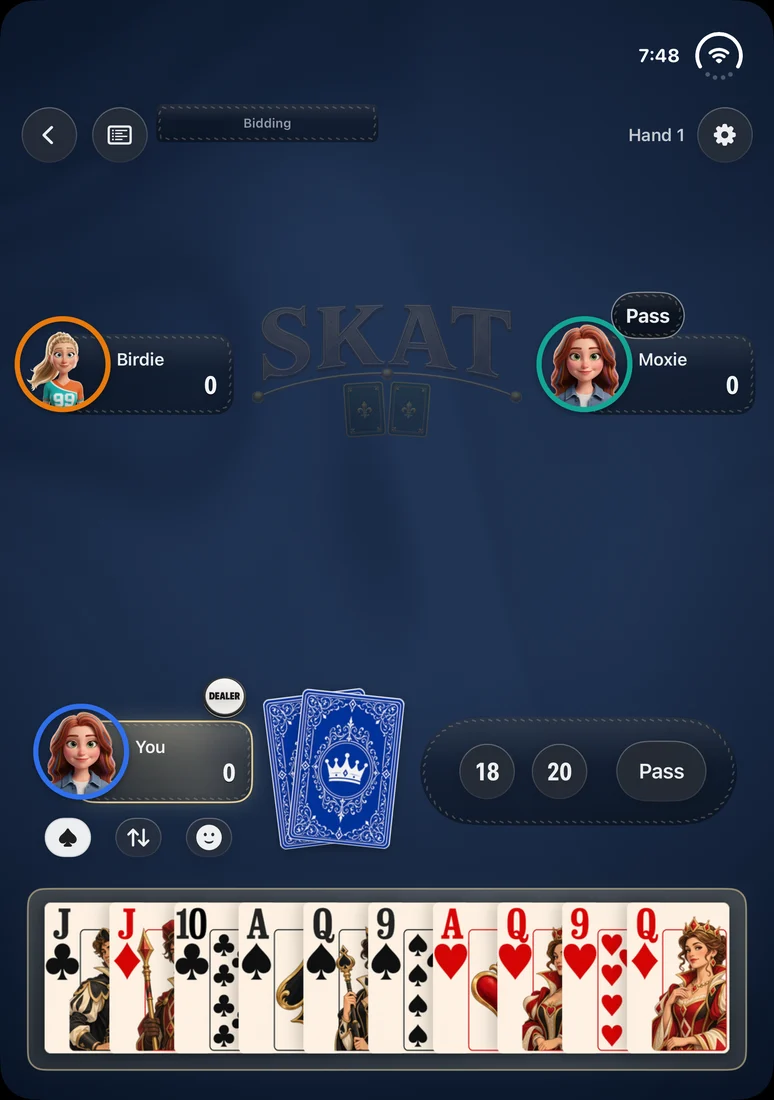
Players bid a game value, not a number of tricks, and every bid is a rung of a fixed ladder: 18, 20, 22, 23, 24, 27, 30 and on up. Middlehand calls values to forehand, who holds each one or passes. Then rearhand calls to whoever is left. Every call must be higher than the last. The last one standing is the declarer. If both others pass without a bid, forehand may take it at 18; if forehand passes too, the hand is thrown in and the deal moves on.
A suit game is worth its base times the multiplier: diamonds 9, hearts 10, spades 11, clubs 12. A grand's base is 24. Null games have fixed values: 23 with the skat, 35 as dealt, 46 with your hand shown, 59 both. Never bid more than the game you mean to play is worth.
The declarer may pick up the two skat cards and discard any two, or play the hand as dealt. Exactly two cards go back down, and their points count for the declarer at the end of the hand. Playing it as dealt is worth more. Then the declarer names the game: a suit as trump, a grand, or a null where the aim is no tricks.
The play
In a suit or grand game, every jack is trump, whatever its suit, ranking clubs, spades, hearts, diamonds, above the ace of trump. A led jack calls for trump. In a suit game the named suit joins the jacks as trump. In a grand only the jacks are trump. In a null there is no trump at all, and every suit runs ace, king, queen, jack, ten, nine, eight, seven.
Forehand, the seat left of the dealer, always leads the first trick. Follow what was led, trump or suit, if you hold it. Otherwise play anything. There is no restriction on leading trump.
Below the jacks, the trump suit runs ace, ten, king, queen, nine, eight, seven: the ten sits above the king. Every plain suit keeps that order too.
Scoring
Aces are worth eleven, tens ten, kings four, queens three and jacks two. Sevens, eights and nines are worth nothing. One of each is thirty, so the whole deck holds a hundred and twenty. The declarer needs sixty-one of them.
A suit or grand game is its base times a multiplier: one for the game, one per matador (top trumps held, or missing, in an unbroken row from the club jack), one for playing as dealt. Hearts have a base of ten, so this game is forty. Win it and forty is added. Lose it and it costs double. Matadors count from twelve cards: the skat is yours for this, even in a hand game where you never saw it.
Schneider adds one: the declarer takes 90 card points, or is held to 30. Schwarz adds one more: one side takes every trick. Both count against a losing declarer too. Playing as dealt, you may announce schneider or schwarz for one more each, or play ouvert, your hand face up from the first lead. Miss an announcement and you lose. Ouvert includes schwarz announced, which includes schneider announced. A table may switch off ouvert or the announcements.
Your game must be worth at least your bid, or you lose even with 61. A suit or grand is then priced at the smallest multiple of its base that reaches the bid, doubled. Bid 36 and play hearts worth 30: that is priced as 40, so you lose 80.
Winning
A match is twelve hands unless the table sets 3 to 24, always a multiple of three. Only the declarer's score moves each hand, so a score can go below zero. After the last hand, the highest score wins. Equal scores share a place, so two players can finish first together.