


The goal
In Canasta you and your partner build melds of one rank. Seven cards of a rank is a canasta. Canastas are where the big points are. The first side to five thousand wins.
The deal
Four players in two partnerships. You play with the seat across from you. The player left of the dealer goes first, and play moves clockwise.
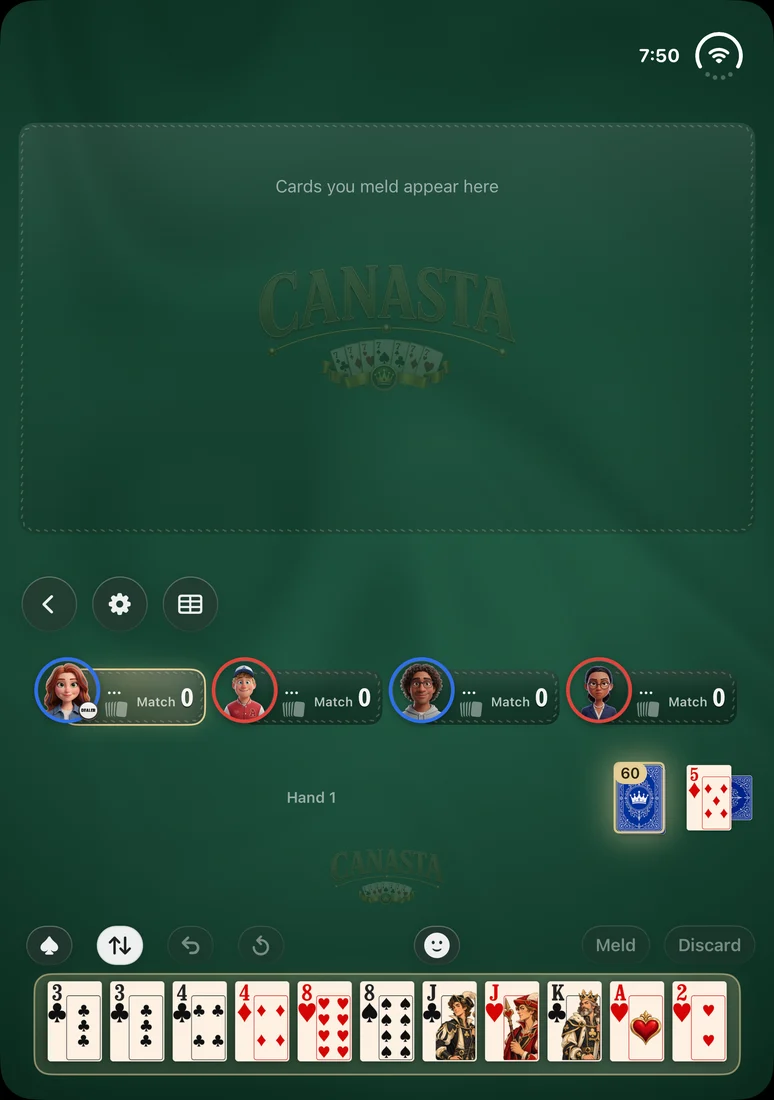
Two full decks plus four jokers make a hundred and eight cards. Eleven cards each. Jokers and twos are wild. They can stand in for any rank in a meld.
A red three never stays in your hand. Dealt or drawn, it goes to your side's row at once and you draw a replacement. One buried in a pile you take goes down too, with no replacement. Red threes are never melded or discarded.
A black three thrown on the pile blocks the next player from taking it, for that one turn only. Black threes are melded only as you go out: three or four of them, never with a wild card.
Every card has a value. It counts for you on the table and against you in your hand when the hand ends. A red three has no value of its own: it is a bonus, scored separately.
The play
Your turn has three parts. Draw one card from the stock, or take the whole pile. Meld if you wish. Discard one card to finish. You always keep one card to discard. You can never meld your last card.
There are no runs. A meld is three or more cards of one rank. It needs at least two natural cards, and it may hold no more than three wild ones.
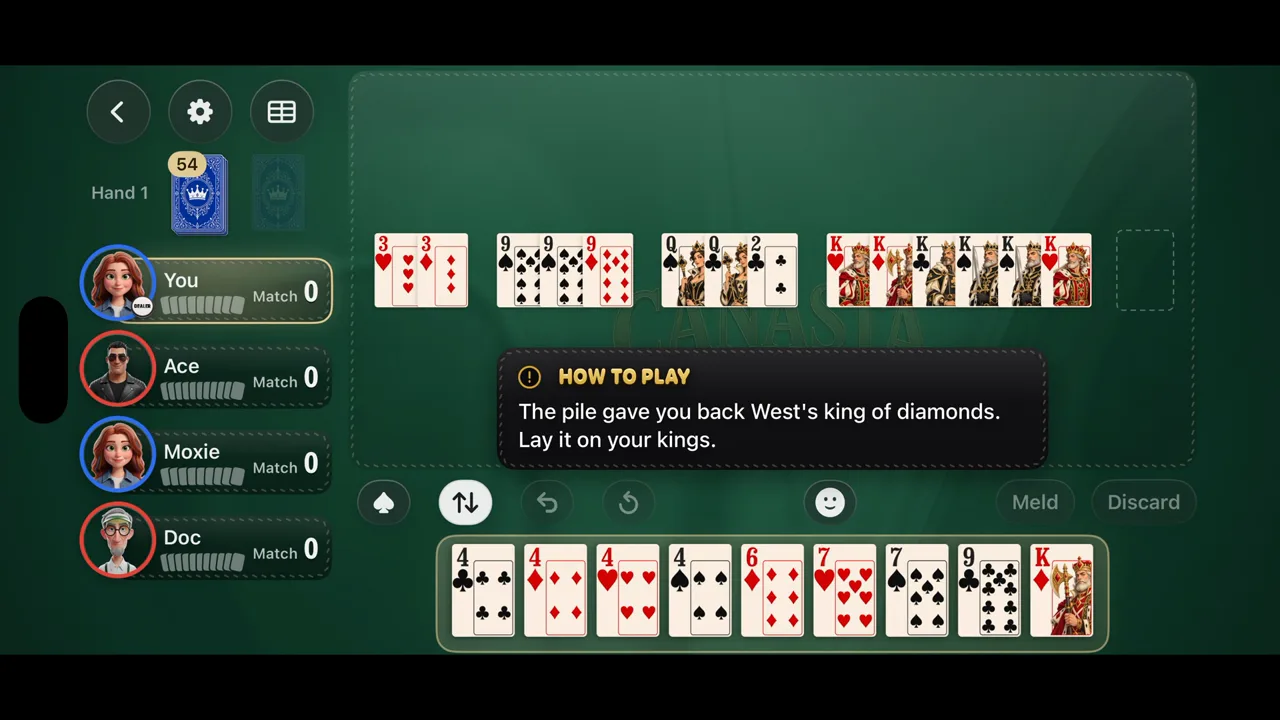
Melds belong to your side, not to you. Either partner may add cards to any of them, on any turn after drawing. A side holds one meld per rank. A second group of kings is never started; the kings go onto the kings.
Your side's first meld of a hand must be worth a minimum. It depends on your side's score when the hand began, not on the score as it moves.
Only what you lay in one action counts toward it, at face value: several groups together if you need them, no bonuses, nothing buried in the pile. Three kings alone are thirty, short of fifty, and would be refused.
Instead of drawing you may take the whole pile, if you can meld its top card at once. The top card must go into a meld of its own rank this turn.
If your side already melds that rank and the pile is not frozen, the top card joins that meld on its own. Nothing from your hand is needed.
Otherwise the top card needs two cards from your hand that make a legal meld with it: two natural cards, or one natural and one wild while the pile is not frozen.
A wild card thrown on the pile freezes it for everyone until it is taken. If the first card turned is a wild or a red three, it is covered and the pile starts frozen. A frozen pile is taken only with two natural cards of the top rank from your hand, even onto a meld your side already has. While a wild is on top, nobody can take it.
Until your side has melded, every pile is frozen against it, whatever is in it. Taking it then is also your opening: the top card plus what you lay from your hand must reach the minimum. The buried cards never count.
When you can meld all but one card and discard the last, you go out and the hand ends for everyone. Your side needs a canasta first. Nobody asks their partner. Black threes may be melded only on this turn.
Scoring
At the end of a hand your side adds its bonuses and the face value of every melded card, then subtracts what is left in both partners' hands. This is the lesson's hand: 1,365.
A natural canasta, seven or more of a rank with no wild card, is five hundred. A mixed one, with one to three wild cards, is three hundred. Adding a wild card to a natural canasta makes it mixed. Legal, and sometimes worth it to go out.
Red threes pay a hundred each, eight hundred for all four. If your side never melded that hand, they count against you instead.
Going out pays a hundred. Going out concealed pays two hundred in its place: your side had melded nothing before the turn you went out on, so you lay down your whole hand in that one turn.
Winning
When the last stock card has been drawn, the hand ends after that turn. Unless that player goes out, nobody gets a going-out bonus; both sides are scored as they stand.
Hands are played until a side ends one with five thousand or more, ahead of the other. A tie at the target plays another hand. After forty hands the higher score wins, whatever it is; level scores are a draw.