


The goal
In Machiavelli you want to be the first to empty your hand onto the table. The whole table is yours to rebuild on the way, as long as every group still works.
The deal
Two full packs plus four jokers. Thirteen cards each, and the table starts completely empty. The rest is the stock. There is no discard pile. The deal moves one seat along every hand, dead hands included, and the player after the dealer starts.
The play
A meld is three or four of one rank in different suits, or three or more in sequence in one suit. An ace may sit at either end of a run, but a run never wraps past the king. Even with two packs, a set never holds two cards of one suit. A run may stretch from ace to king to ace, fourteen long.
On your turn you either add to the table or draw one card. That is the whole turn. There is no draw-then-discard. Once the stock is empty, drawing is refused ("There is nothing left to draw.") and you may pass instead. Heads up the stock starts at 82 cards, 13 fewer for each extra player. There is no opening minimum. Your first cards may be any legal meld, and one turn may put down as many cards as you can place, even your whole hand.
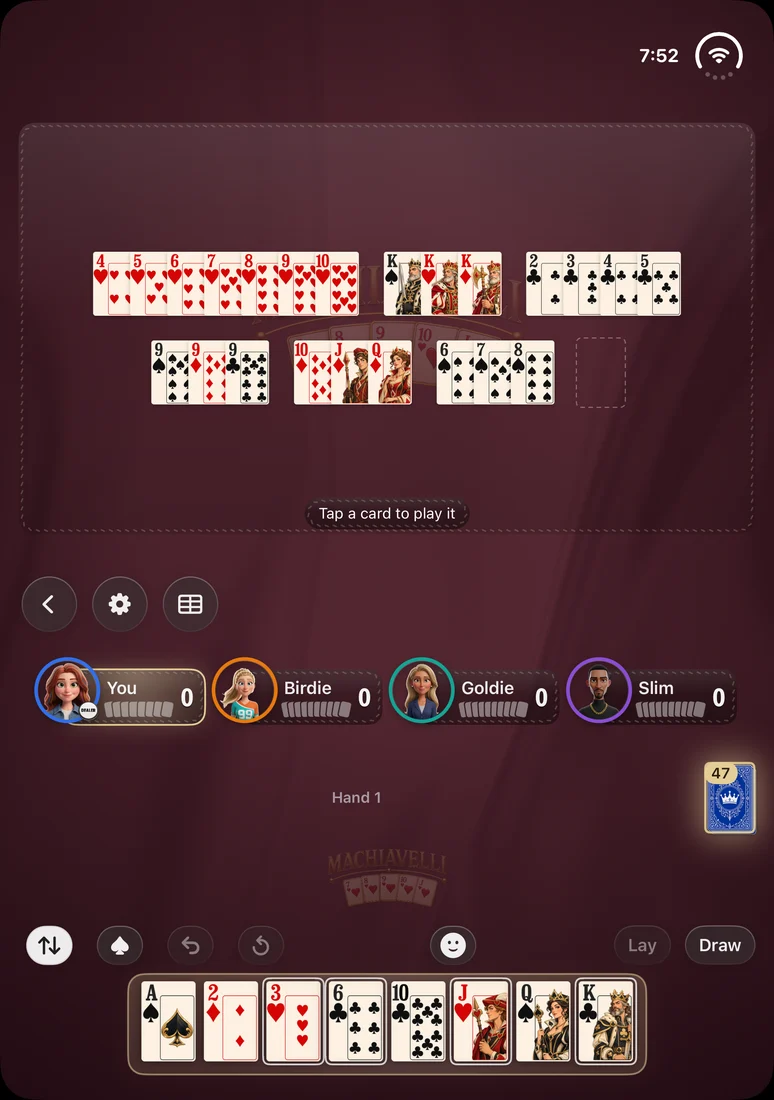
You may move, split and recombine anything already on the table, however you like. Here a six leaves a run of three to six, which stays legal, and joins two sixes from your hand.
Nothing may leave the table. Every card that was down before must still be down afterwards. You must add at least one card from your own hand. Rearranging alone is not a turn. Every group you leave behind must be a legal meld in its own right.
A joker stands in for whatever the group needs. In a run, where you place it decides what it is. Every meld needs at least two real cards, so a three-card meld may hold only one joker and a four-card set two.
A joker on the table moves like any other card, as long as the group it leaves still stands. Put a real card in its place and the joker is free. It never goes into your hand. Nothing may leave the table, so a freed joker must go back down somewhere else this same turn.
Scoring
Empty your hand and you score every card still held by everyone else. A joker is twenty-five, an ace eleven, tens and face cards ten, and the rest their face value. A joker left in your hand costs twenty-five, so play jokers early, and watch how many cards the others hold before you keep cards back.
If everybody passes in turn, the hand is dead and nobody scores. A new hand is dealt.
Winning
Hands are played until one player alone holds the top score at one hundred or more. That player wins. After 40 hands the leader wins even below one hundred, and a tie for the lead then has no winner.